
.png)

.png)
.png)





# Complete Guide to Roulette Betting Progressions
Roulette players have experimented with betting progressions for centuries, creating dozens of different staking systems designed to manage wins, losses, and bankrolls. While every system has its own philosophy, it's important to remember one simple fact:
**No betting progression can overcome the house edge or guarantee long-term profit.** Each system simply changes **how much you bet and when**, affecting risk, volatility, and bankroll management.
Below is a complete guide to the most popular roulette betting progressions.
---
# 🔺 Negative Progressions (Increase After a Loss)
Negative progressions attempt to recover previous losses by increasing the bet after losing spins.
## Martingale
**Progression:**
1 → 2 → 4 → 8 → 16 → 32 → ...
**How it works:**
Simply double your stake after every loss. One win recovers all previous losses and earns one unit profit.
**Pros**
* Simple to understand
* Recovers losses quickly
**Cons**
* Stakes grow extremely fast
* Can hit table limits
* Requires a very large bankroll
---
## Double Martingale
**Progression:**
2 → 4 → 8 → 16 → 32 → 64...
**How it works:**
Identical to the Martingale but starts at double the normal base stake.
**Risk:** ★★★★★
---
## Grand Martingale
**Progression:**
1 → 3 → 7 → 15 → 31 → 63...
(Double previous bet, then add one extra unit.)
**How it works:**
Designed to recover losses while also winning an additional unit after a successful recovery.
**Pros**
* Faster recovery
**Cons**
* Even steeper than Martingale
---
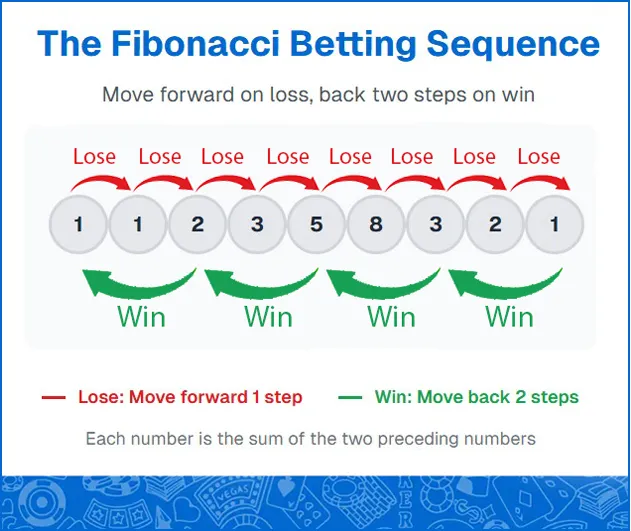
## Fibonacci
**Sequence:**
1, 1, 2, 3, 5, 8, 13, 21, 34...
**How it works:**
Move one step forward after a loss and two steps back after a win.
**Risk:** Moderate to High
---
## Fibonacci Extended
**Sequence**
A longer Fibonacci progression such as:
1,1,2,3,5,8,13,21,34,55,89...
Designed for longer losing streaks before reaching the end of the sequence.
---
## Reverse Fibonacci
**Typical Sequence**
8,5,3,2,1...
A compressed or reversed version of Fibonacci where the movement through the sequence differs from the classic approach.
---
## Labouchère (Cancellation System)
**Starting Sequence**
1 - 2 - 3 - 4 - 5 - 6
**Bet**
First + Last
Example:
1+6 = 7 units
Win:
Remove both numbers.
Loss:
Add the lost stake to the end of the line.
Continue until every number has been cancelled.
**Pros**
* Flexible
* Customisable sequence
**Cons**
* Can become very large during losing runs
---
## Labouchère Aggressive
**Starting Sequence**
1 - 3 - 5 - 7 - 9
Uses much larger starting numbers, creating bigger bets and higher volatility.
---
## D'Alembert
**Progression**
1 → 2 → 3 → 4 → 5...
Increase by one unit after each loss.
Decrease by one unit after each win.
Designed around the idea that wins and losses should eventually balance out.
---
## D'Alembert Steep
**Progression**
1 → 3 → 5 → 7 → 9...
Increase two units after every loss.
A much more aggressive version of the classic system.
---
## Contra D'Alembert
Also called the Reverse D'Alembert.
Rather than chasing losses, this progression increases after wins and decreases after losses, creating a much gentler betting pattern.
---
## Whittacker
A lesser-known slow progression based loosely on Fibonacci principles.
Designed to increase stakes gradually, making it friendlier to smaller bankrolls.
---
## 3/2 Progression
Uses alternating increases similar to:
1 → 1 → 2 → 3 → 3 → 5...
The idea is to climb slower than Martingale while still attempting gradual recovery.
---
## Negative 1-3-2-6
Instead of using the famous positive 1-3-2-6 sequence, this version attempts to recover losses by moving through the sequence after losing bets.
It is considerably more aggressive than the original.
---
## Hollandish
Increase the stake only after every three consecutive losses rather than after every single loss.
Example:
Loss
Loss
Loss
Increase
This creates a much slower progression.
---
## Parlay Negative
A hybrid progression that combines elements of Parlay and Martingale, resulting in rapid stake increases after losing spins.
One of the highest-risk systems.
---
# 🔻 Positive Progressions (Increase After a Win)
Positive progressions attempt to maximise winning streaks while limiting losses.
---
## Paroli
**Progression**
1 → 2 → 4
After three consecutive wins, return to the starting stake.
Often called the Reverse Martingale.
---
## 1-3-2-6
**Sequence**
1 → 3 → 2 → 6
One of roulette's best-known positive systems.
If all four bets win:
Total profit = 12 units.
Any loss resets back to the beginning.
---
## Oscar's Grind
Increase by one unit only after winning bets.
Remain at the same stake after losses.
The aim is to finish each session one unit ahead.
Very popular among conservative players.
---
## Reverse Martingale
Simply double after every win.
Example:
1 → 2 → 4 → 8
Reset after a loss.
Attempts to capitalise on winning streaks.
---
## Reverse D'Alembert
Increase by one after wins.
Decrease after losses.
A slower, steadier alternative to Reverse Martingale.
---
## Reverse Labouchère
Uses a cancellation system in reverse.
Instead of removing numbers after wins, the sequence grows during successful streaks to maximise profits.
---
## Up As You Win
A gentle positive progression.
Increase stakes slowly after wins rather than doubling.
Ideal for players wanting lower volatility.
---
## Pyramid
Increase gradually during a winning streak before stepping back down after reaching a peak.
Example:
1 → 2 → 3 → 4 → 3 → 2 → 1
Designed to lock in profits while reducing exposure.
---
# ➡️ Flat & Conservative Systems
These systems focus more on bankroll preservation than rapid recovery.
---
## Flat Betting
**Progression**
1 → 1 → 1 → 1 → 1...
The same stake is used every spin.
Many experienced players prefer flat betting because it avoids huge swings.
---
## Zach Attack Default
**Sequence**
1, 1, 1, 2, 2, 3, 3, 4, 5, 7
A custom progression designed to increase slowly while avoiding the explosive growth of Martingale.
It blends several progression ideas into one gradual staking plan.
---
## Conservative
A gentle climbing progression with small increases and slow recovery.
Designed to minimise bankroll volatility.
---
## Ultra Conservative
The slowest progression in the list.
Uses very gradual increases, making it suitable for long sessions and smaller bankrolls.
---
## Medium
A balanced progression sitting between conservative systems and aggressive loss-chasing systems.
Offers moderate growth without the rapid stake escalation seen in Martingale-style progressions.
---
# Which Progression Is Best?
There is no universally "best" roulette progression. Each one makes different trade-offs between risk, reward, bankroll requirements, and volatility.
Generally speaking:
* **Highest Risk:** Martingale, Grand Martingale, Double Martingale
* **Moderate Risk:** Fibonacci, Labouchère, D'Alembert
* **Lower Risk:** Oscar's Grind, Up As You Win, Flat Betting
* **Most Conservative:** Flat Betting, Ultra Conservative
Ultimately, betting progressions change **how you distribute your wagers**, not the mathematical odds of roulette itself. They can make sessions feel very different, but they do not change the long-term house advantage. If you choose to experiment with any progression, always use sensible bankroll limits and play responsibly.