Crypto Trading Trainer
This is a paper-trading learning game designed to help you practise
how crypto trading works without risking real money.
NO REAL MONEY OR CRYPTO IS USED.
Your cash balance, purchases, sales, profits and losses inside this trainer are
completely fake. You cannot deposit, withdraw, win or lose real money here.
So what is real?
In Real Market Mode, we put your fake training money
against real cryptocurrency market results supplied by CoinGecko.
This means the coin prices can follow the real market while your account and every
trade remain completely simulated.
Two ways to practise
- Simulated Market: faster fictional price movements for quick practice.
- Real Market: fake-money paper trading using real GBP crypto market data from CoinGecko.
What can I learn?
Practise buying and selling, Market Orders, Limit Orders, Stop Loss and Take Profit,
Open Orders, trading fees and spread, portfolio value, average entry price,
profit/loss and trade history.
📈 Understanding Chart Patterns
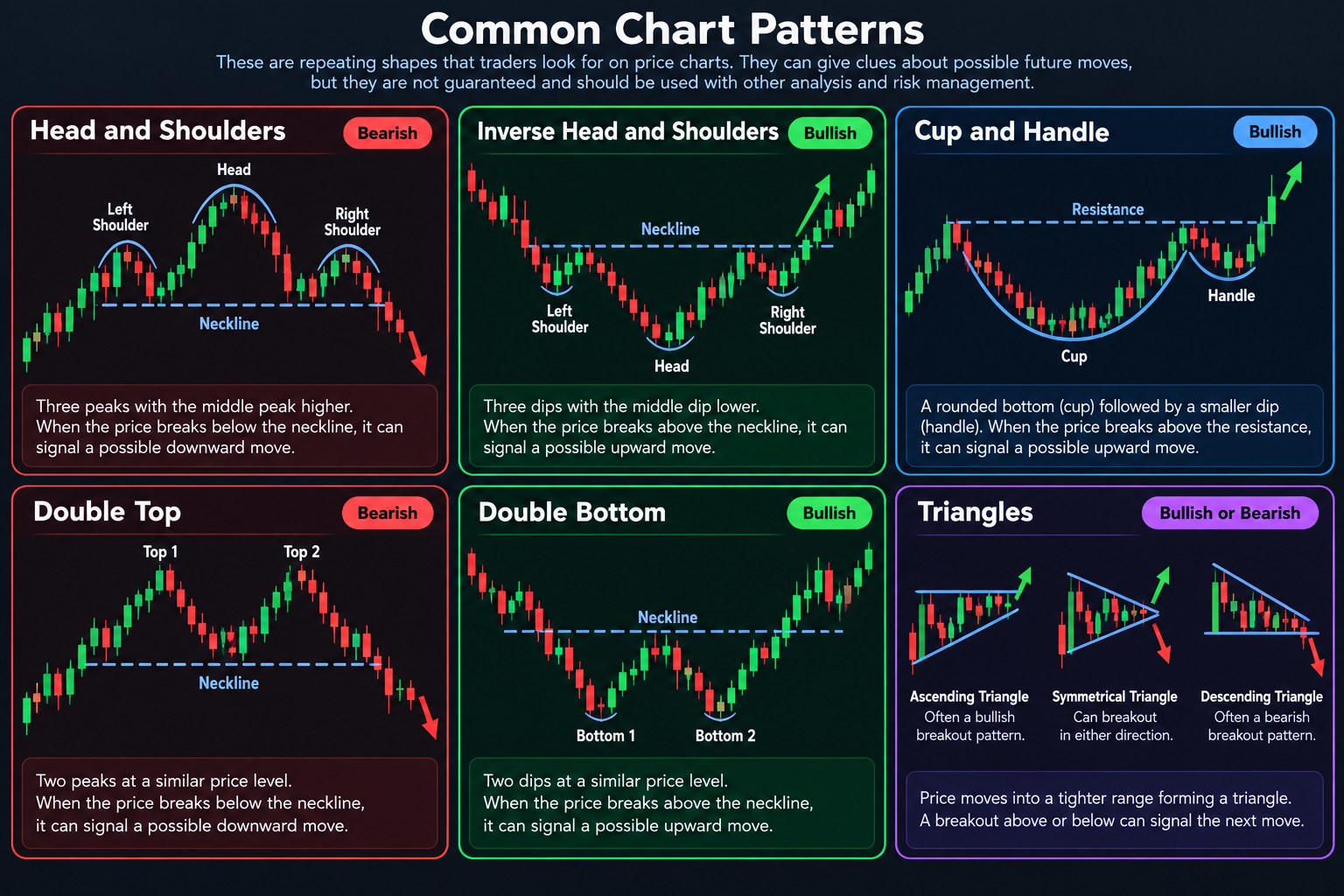
Traders sometimes look for repeating shapes in price charts. This is called technical analysis. Patterns are clues about possible buying and selling behaviour, not reliable predictions or guarantees. Similar shapes can also appear in random price movements.
Head and Shoulders — Possible bearish reversal
Three peaks: a smaller left shoulder, a higher middle head, and a smaller right shoulder. Traders watch the neckline joining the lows between peaks. A move below that neckline may suggest weakness, but false breaks happen.
Inverse Head and Shoulders — Possible bullish reversal
The upside-down version has three troughs, with the middle trough deepest. Traders look for a break above the neckline as a possible bullish signal.
☕ Cup and Handle — Often considered bullish
A rounded dip forms the cup, followed by a smaller pullback or sideways move forming the handle. Traders watch for a break above resistance near the cup rim. Not every rounded chart is a valid setup.
Double Top (M) and Double Bottom (W)
A double top has two peaks around a similar level and may suggest selling pressure if support breaks. A double bottom has two lows around a similar level and may suggest buying strength if resistance breaks.
Triangles — Watching for breakouts
When price swings become narrower, they can form ascending, descending or symmetrical triangles. Traders watch whether price eventually breaks upward or downward. The direction is never certain.
Remember: Patterns are not a trading system by themselves. Even random charts can form convincing shapes. Practise on the trainer with fake money, and judge patterns by recorded results rather than appearances.
Important
This trainer is for education and entertainment only. It is not a
real exchange, broker, wallet or investment service, and nothing shown here should
be treated as financial advice. Real cryptocurrency markets can be highly volatile
and real trading can result in financial loss.
Live/reference cryptocurrency data in Real Market Mode is provided using CoinGecko.
Trainer fees, spread and simulated-market behaviour are learning features and do
not represent the exact terms of any particular real exchange.